Smart Video & Analytics
Turn video events into actionable operational signals.
Use supported video events as inputs for rules, workflows and infrastructure control.
Challenge
Cameras produce footage. Operations need events.
Video is usually the best-instrumented part of an installation and the least connected to anything else.
Footage nobody has time to watch
Continuous recording is evidence after the fact. It is not something an operator can act on while it matters.
Detections that stay in the VMS
A camera that recognises a category of object often keeps that knowledge inside its own system, where no rule can reach it.
No shared vocabulary
A detection, a meter reading and a device state are three different kinds of thing in three different tools, so they cannot be combined into one condition.
Architecture
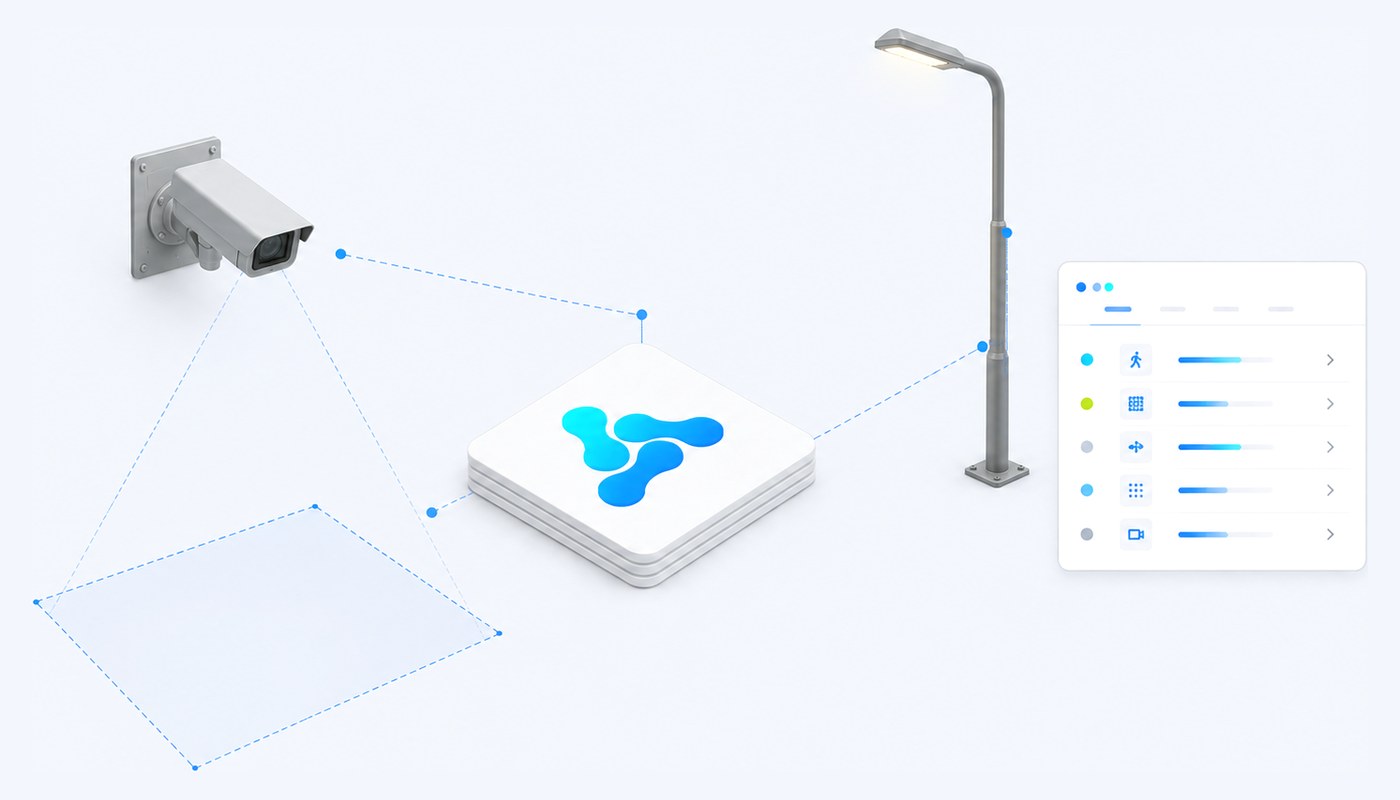
A detection becomes an operational event.
The documented use case is differentiated presence: cameras and computer vision detect categories of objects or people, and the result can influence how other equipment behaves.
›
›
›
›
What each stage becomes in the platform
Operational scenario
A pedestrian on an empty street.
The documented case: differentiated presence detection influencing the light level of nearby luminaires.
Illustrative example
1
The camera detects a category
Computer vision distinguishes a pedestrian from a vehicle inside a configured zone.
2
The event becomes a metric
It is stored with a value and a timestamp, on the camera instance it came from.
3
A rule reads the scenario
The condition combines the detection with the scenario currently active and, if relevant, the time of day.
4
A command goes to the luminaires
The rule effect raises the light level on the group covering that stretch, through their own command template.
5
The devices confirm
Response metrics report the level actually applied, and the command carries its state.
6
It returns to baseline
A second rule, or the same one on a different condition, brings the level back down when the scenario says so.
This example is illustrative. Which categories are detected, which scenarios exist and how equipment responds are configured per deployment.
Operational scenario
Outcome
Connect situational awareness with operational response.
Inside the platform.
What it is built on
The platform capabilities behind this solution.
The value is not in the camera. It is in what the rest of the platform can do once a detection becomes data.
Data, Metrics & Commands
Detections stored as metrics with values and timestamps, and commands that carry the response back to equipment.
Rules & Automation
Conditions that combine a detection with time, scenario and values from entirely different devices.
Digital Twins & Device Lifecycle
Cameras and the equipment they influence, modelled as versions and instances in the same registry.
Connectivity & Integration
Protocols and integrations as configurable service instances, including HTTP-based event delivery.
GIS & Spatial Operations
Cameras and affected groups on the interactive map, so an event has a location.
Security & Audit
Roles and permissions over who may see and act, with a change history on the configuration.
Fit with what you already have
See how Vision can fit your deployment.
Share your current devices, connectivity and operational objectives.