Industry & Critical Infrastructure
Connect telemetry, control and operational workflows.
Build a configurable operational layer across industrial and critical assets.
What these operators run
Sites where being wrong is expensive.
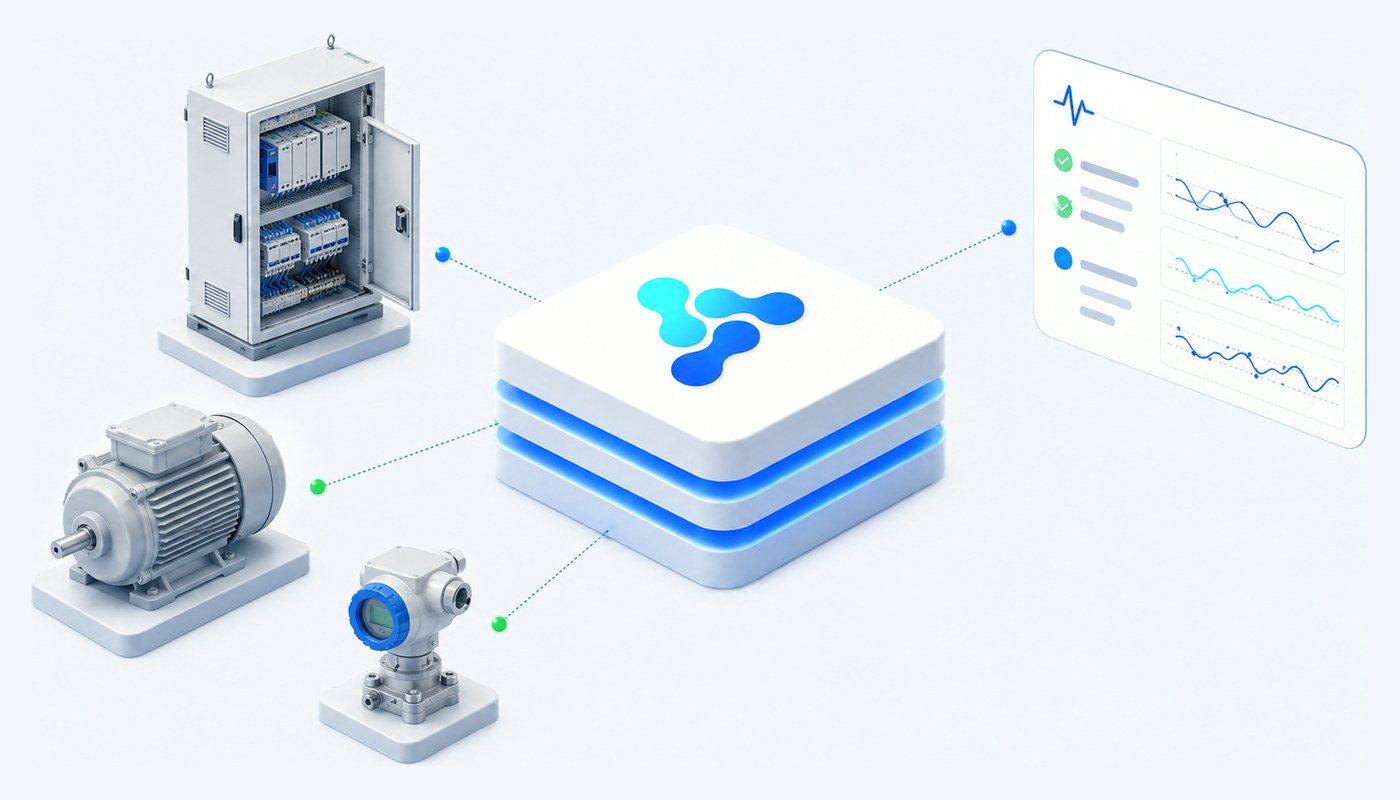
Industrial and critical infrastructure operators already have control systems. What they usually lack is one administrable layer above them.
Process and utility equipment
Pumps, motors, valves, instruments and the controllers that drive them, often from several suppliers and several decades.
Site infrastructure
Lighting, energy, environmental conditions and access — usually operated separately from the process itself.
Distributed sites
More than one location, each with its own supervision, and a head office that needs to compare them.
Local automation
Logic that must stay local for reasons of latency and safety, and is not going to be moved into a platform.
Obligations to demonstrate
Whether the auditor is internal, a regulator or a customer, the answer has to be reconstructible.
People who change
Shifts, contractors and turnover. Whatever is only in someone’s head leaves when they do.
Where it gets hard
Supervision is local. Accountability is not.
The gap between what a site knows and what the organisation can demonstrate is where most of the effort goes.
Each site is its own island
Two plants running the same process often cannot be compared, because their supervision systems disagree about what a tag means.
Actions are hard to reconstruct
Knowing that a command was sent is not the same as knowing it was received, applied and confirmed — especially months later.
Replacing control is not an option
Anything that requires touching safety or real-time logic to get better reporting is a non-starter, and rightly so.
What the platform adds
An administrable layer that leaves control alone.
Everything here sits above local automation rather than inside it.
Assets described the same way everywhere
Equipment at every site becomes model, version and instance, so two plants finally agree on what a device is.
Telemetry in one comparable model
Metric templates persist values with shared units and timestamps, which is what makes cross-site comparison meaningful.
Commands that confirm themselves
A command template names the response metrics that validate it, and the command carries a state over time.
Rules above the process
Conditions on metrics, parameters and time, with priorities — for operational automation, not for safety interlocks.
Sites as IoT systems
Each installation carries its own inventory, dashboard, retention policy and the parties responsible for it.
Groups that match the plant
Equipment can be grouped the way it is actually operated, and commanded or visualised at that level.
Access that reflects the organisation
Organisational units, roles and permissions decide who may see and who may act, per unit rather than per person.
A reconstructible record
Practically every entity carries a change history with old and new values, alongside metric history and command states.
Local control untouched
Safety and real-time behaviour stay where they belong. Nothing here requires changing them.
Where to start
The solutions these operators usually deploy first.
Most begin with the layer that does not touch the process, then extend inwards.
Smart Infrastructure / SCADA
A supervisory layer over existing control: telemetry in one model, validated commands, shared history.
Smart Metering
Energy and utility consumption per site and per line, timestamped and comparable.
Smart Environment
Conditions inside and around the site as comparable metrics, with thresholds that act.
Smart Lighting
Site and perimeter lighting under the same registry and the same rules as everything else.
Smart Video & Analytics
Detections as operational events that rules can combine with process and site data.
Smart Buildings / BMS
Offices and technical buildings on the estate, operated as a portfolio.
What it is built on
The platform capabilities behind this deployment.
Each has its own page, with what it does and how it is configured.
Digital Twins & Device Lifecycle
Equipment as models, versions and instances, organised into IoT systems and groups per site.
Data, Metrics & Commands
Metric templates for telemetry, command templates with response validation and command state over time.
Rules & Automation
Operational automation above the process, with priorities and enable or disable.
Security & Audit
Identity, roles and permissions per organisational unit, with a change history that records old and new values.
Connectivity & Integration
Protocols as containerised service instances, plus CODEC definitions where payloads need decoding.
Dashboards & Visualization
Operational screens per site and per audience, from a widget palette.
Fit with an industrial estate
Discuss your infrastructure.
We will help map your current architecture and operational goals to Vision.