Defence
Digital superiority through connected operations.
Integrated IoT, analytics and process automation for armed forces and security organizations.
Operational challenges
Dispersed sites, mixed equipment, manual reporting.
The infrastructure problems are recognisable. The constraints around them are not.
Systems that do not meet
Sites and functions were equipped separately, each with its own supervision, and none of them was designed to share a picture.
Dispersed bases and assets
What is being operated is spread across locations where a physical check is slow and expensive.
Manual reporting
Status that has to be assembled by people, on a schedule, is out of date before it is read.
Limited real-time context
A value without the asset it belongs to, its location and its history cannot support a decision under time pressure.
Multi-vendor infrastructure
Equipment from many suppliers and many generations, none of which is going to be replaced to simplify the software.
What the platform does
Site and asset infrastructure, in one operational model.
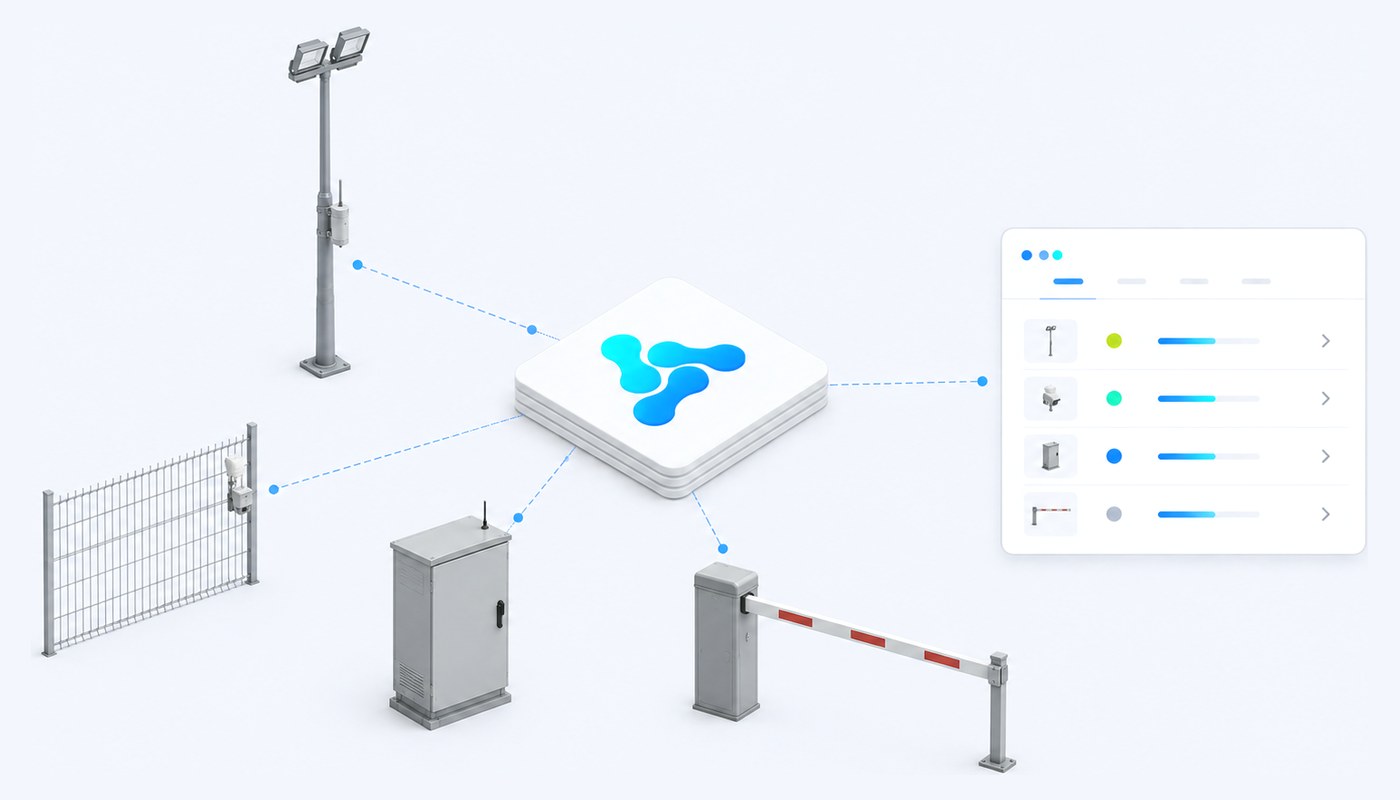
Vision Smart Platform is a connected-infrastructure platform. On a base or a secured site, that is what it does — and being precise about the boundary is part of being useful.
Modular by construction
Each layer can be adopted on its own. A site can start with one domain and add the next on the same foundation.
Equipment described, not standardised
Models, versions and instances describe arbitrary equipment, so a mixed estate is the normal case rather than an exception.
Protocols as service instances
A protocol is a configurable, containerised service. Adding one is provisioning, not development.
Automation through rules
Conditions on metrics, parameters and time trigger commands, notifications or parameter changes, with priorities.
Access modelled on the organisation
Organisational units, roles and permissions determine who may see and who may act.
A complete change history
Practically every entity carries an audit section recording who changed what, with the old and the new value.
Where the boundary is. The platform operates connected infrastructure: devices, telemetry, rules, dashboards, maps and the registry behind them. It is not a command-and-control system, and it does not make targeting or engagement decisions.
Where it fits
The parts of a site the platform actually operates.
Each of these maps to a documented platform capability, applied to a base or a secured site.
Bases and facilities
Lighting, energy, environmental conditions and technical equipment across buildings, operated as a portfolio rather than site by site.
Site and perimeter infrastructure
The connected equipment around a site — lighting, sensors and cameras — modelled in one registry, with detections available to rules.
Asset registry
Every unit as an instance of a version and a model, with its location, its parameters and its full lifecycle from enrollment to retirement.
Environmental monitoring
Temperature, humidity and particulate readings as comparable metrics, with thresholds that raise something on their own.
Energy and metering
Consumption per site, per building or per line, timestamped and comparable between periods.
Operational awareness
Dashboards and interactive maps that show the state of the estate, per audience and per installation.
What is deliberately not claimed. The platform has no predictive or machine-learning analytics, no logistics or supply-chain module, and no HR, finance or document-management functions. What it offers in those areas is data other systems can consume through the integration APIs.
Solutions built for this environment.
What it is built on
The platform capabilities behind this deployment.
Each has its own page, with what it does and how it is configured.
Digital Twins & Device Lifecycle
Every asset as model, version and instance, with a lifecycle from enrollment to retirement.
Security & Audit
Identity and access management, roles and permissions per organisational unit, and a change history with old and new values.
Rules & Automation
Conditions on metrics, parameters and time, with priorities and operational enable or disable.
GIS & Spatial Operations
Assets, groups and systems on the interactive map, with filters and map profiles per view.
Connectivity & Integration
Protocols as containerised service instances, with device enrollment and integrations.
Enterprise Administration
Organisational units, operators, states, units of measure and the holiday calendar.
Deployment considerations
Discuss your infrastructure.
We will help map your current architecture and operational goals to Vision.