Utilities
Operate distributed utility infrastructure with real-time context.
Connect meters, field equipment, gateways, dashboards, alerts and automation.
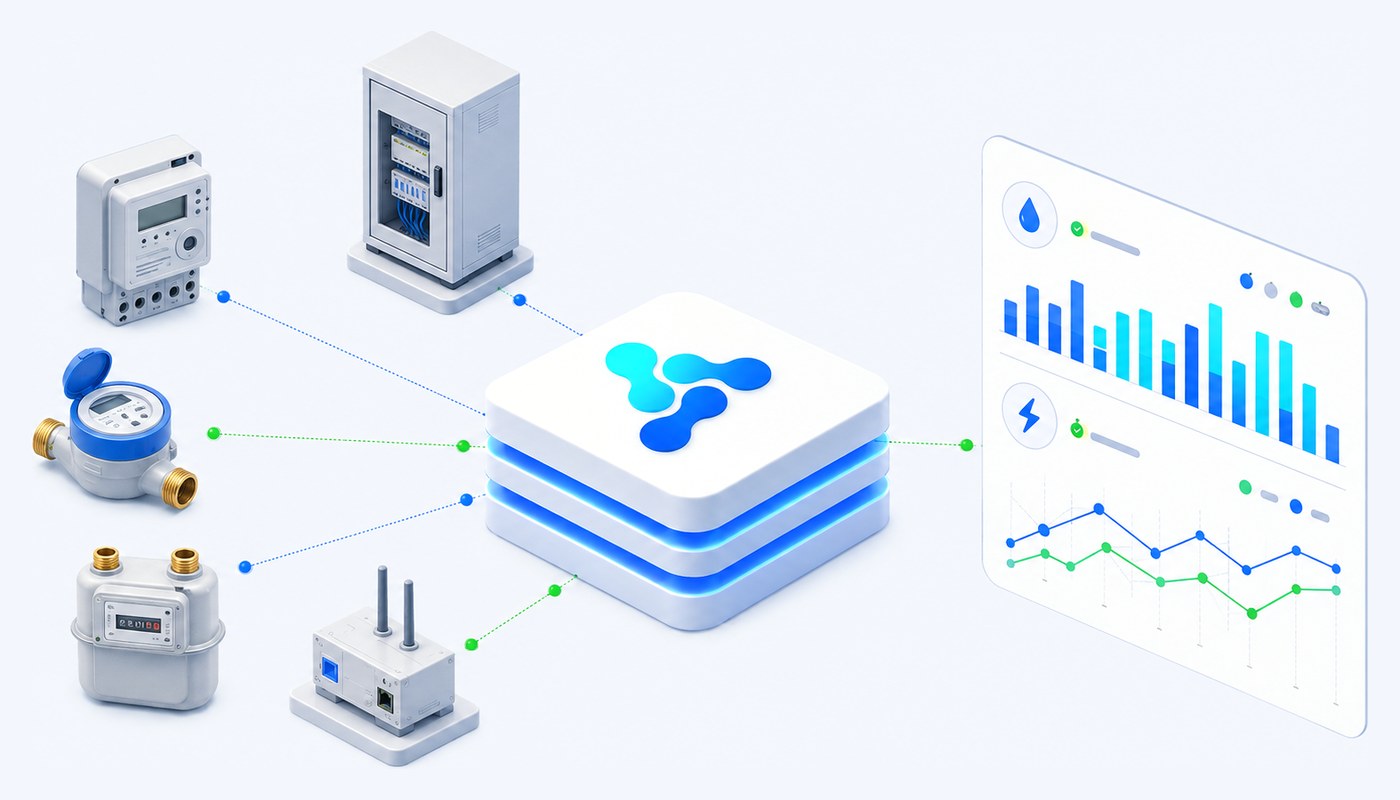
What a utility operates
Assets in the ground, spread over a service territory.
The estate is large, distributed, and mostly somewhere nobody is standing.
Metering at scale
Electricity, water or gas meters across an entire customer base — the most numerous assets, and the ones the business is measured on.
Network equipment
Concentrators, controllers and communication units that make remote reading and remote action possible at all.
Distributed installations
Stations, cabinets and points of presence, spread across a territory where a site visit costs a day.
Mixed generations
Equipment installed over decades, from suppliers who no longer exist, none of which will be replaced for the sake of tidier software.
Several communication technologies
LoRaWAN in one area, cellular in another, fibre where it exists — usually all at once.
Obligations
Whatever the regulator, the contract or the internal auditor asks for, the answer has to come out of a system rather than a spreadsheet.
Where it gets hard
Scale turns small inconsistencies into large ones.
A problem that is trivial on one device becomes an operational programme across hundreds of thousands.
A reading that cannot be trusted is worse than none
If the unit, the timestamp or the device it belongs to is uncertain, the value cannot be used for anything that matters.
Silence is the hardest event to notice
A device that stops reporting produces nothing. Without a system that treats absence as a condition, nobody finds out until someone asks.
Every supplier is a small integration project
Each new device family arrives with its own payload format, and if that means a code change, the estate stops being extensible.
What the platform gives a utility
Built for estates that grow by accumulation.
The mechanisms that make a large, mixed, distributed estate administrable.
One device family, described once
A meter type is a model and a version. Ten thousand units of it are instances that inherit everything defined above them.
Readings that carry their meaning
Metric templates persist a value with its unit and timestamp, which is what makes it comparable and defensible later.
Payload decoding without a release
Where a payload needs interpretation, controllers carry their own CODEC definition rather than requiring a change to the platform.
Absence as a condition
Device state and the age of the last value can be evaluated by a rule, so a meter that goes quiet raises something.
Protocols added by deployment
Each protocol is a configurable, containerised service instance. Adding one is provisioning, not development.
Grouping by how the estate is run
Areas, routes or contracts become groups and IoT systems, each with its own inventory and retention policy.
Commands where equipment supports them
Command templates define the parameters supplied at execution and the response metrics that confirm them.
Data other systems consume
Integration APIs let billing, ERP or reporting read the same values instead of keeping a divergent copy.
A trail that holds up
Practically every entity carries a change history with old and new values — which matters when a figure is challenged.
Where to start
The solutions utilities usually deploy first.
Metering is normally the centre of gravity. The rest attaches to the same registry.
Smart Metering
Electricity, water and gas meters in one model, with timestamped consumption metrics and rules on what the readings show.
Smart Infrastructure / SCADA
A supervisory layer over existing control at stations and network points, with validated commands.
Smart Environment
Conditions at network assets as comparable metrics, with thresholds that act on their own.
Smart Buildings / BMS
Operational sites and offices as a portfolio, on the same registry as the network.
What it is built on
The platform capabilities behind a utility deployment.
Each has its own page, with what it does and how it is configured.
Digital Twins & Device Lifecycle
Meters, concentrators and network equipment as models, versions and instances, from enrollment to retirement.
Data, Metrics & Commands
Metric templates for consumption, command templates with response validation, and a command state over time.
Connectivity & Integration
Protocols as containerised service instances, plus per-controller CODEC definitions for payload decoding.
Rules & Automation
Conditions on consumption, device state and time, with priorities and operational enable or disable.
Developer & Integration Tools
The APIs a billing, ERP or reporting system uses to read the same values.
Security & Audit
Roles and permissions, and a change history with old and new values on practically every entity.
Fit with a utility estate
Discuss your infrastructure.
We will help map your current architecture and operational goals to Vision.