Ecosystem
One ecosystem. From the physical world to operational decisions.
Vision Smart Platform connects field devices, edge processing, communications, software and operational applications into one configurable ecosystem.
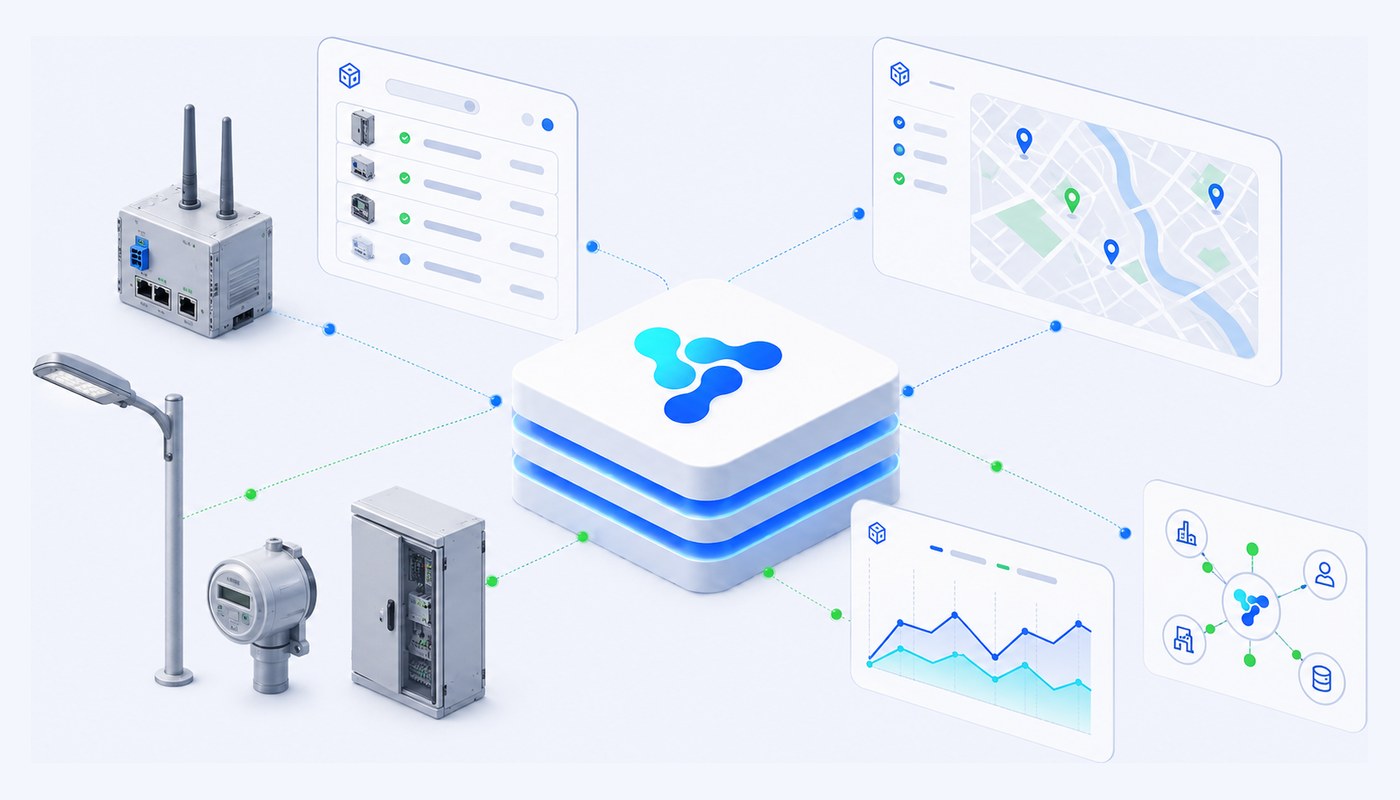
Architecture
Seven layers. One operational model.
The platform is organised as a stack, from the equipment in the field to the screens people work in. Every layer can be adopted on its own — or all of them together.
Devices & Sensors
Sensors, meters, luminaires, cameras, actuators and third-party equipment become managed digital assets — each one attached to a model and a version.
Network & Gateways
Controllers and gateways carry field traffic and hold local control between the equipment and central operations.
Protocol & Integration Services
Each protocol runs as its own configurable, containerised service instance — so adding a protocol is a deployment, not a rewrite.
Data Processing & Standardisation
Incoming payloads are decoded and mapped onto metric templates, so heterogeneous equipment reports into one comparable data model.
Registry & Configuration
Models, versions, instances, groups and nomenclators are defined once and reused across the whole installation.
Rules & Automation
Operational rules evaluate metrics and states, and issue validated commands back to the field.
Visualisation & User Channels
Dashboards, widgets and interactive maps turn the operational model into the screens people actually work in.
Data flow
From field signal to operational action.
The same path applies whether the equipment is a luminaire, a meter or a controller. What changes is the model behind it, not the pipeline.
1
In the field
A sensor or a simple device reports a reading or a state change.
2
Controller or gateway
Controllers and gateways carry the field traffic towards central operations.
3
Protocol or integration service
A configurable protocol instance — or an integration — receives the payload.
4
Decode and map
The payload is decoded and mapped onto the metric templates defined for that device.
5
Persist and operate
The metric is stored and put to work in rules, dashboards and maps.
6
Command back
A rule can issue a validated command to the same device, closing the loop.
Nothing in this path is hard-wired to a device type. Metric templates, command templates and rules are configured per model and version, so a new class of equipment joins the same flow without changes to the platform.
Architectural principles
Built for heterogeneous infrastructure.
Six decisions in the architecture explain why a deployment stays administrable as it grows — and why it does not have to be rebuilt for the next project.
Model once, deploy many
The abstract device model is kept separate from the physical instance installed in the field. One model, one version, and every unit of that equipment inherits it.
Protocols as services, not as code
Protocol management is configurable, through containerised service instances. A new protocol is provisioned, not programmed into the core.
Configured in the interface, not in files
Configuration happens through visual interfaces, which reduces the dependence on manual edits in configuration files.
Dynamic attributes, reused
Metrics, parameters and commands are treated as reusable dynamic attributes rather than a fixed schema imposed on every device.
Every change is traceable
Changes and operational actions are tracked through centralised audit, on the same entities people work with every day.
Extend without rebuilding the core
The platform is designed to extend through integrations and external services, so new capability does not mean a new platform.
Business ecosystem
The commercial relationships live in the same model.
Infrastructure is rarely built, owned and operated by the same organisation. The platform records a company once, and the roles it plays as separate associations to that record.
Company registry
A company is recorded once, with its identifying data and its own change history. Everything else references that single record.
Vendor
The vendor is a mandatory attribute of every equipment version, so each product in the catalogue traces back to who supplies it.
Integrator
The integrator is one of the two mandatory parties on an IoT system — the organisation that builds and maintains the installation.
Customer
The customer is the other. Together they define who an installation belongs to and who is accountable for it.
One company, several roles
Vendor, integrator and customer are associations, not copies. The same company can hold all three at once, and its identifying data stays in one place — changed once, correct everywhere.
Above them sits the IoT system: the operational and administrative context an installation lives in. It ties that installation to a customer and an integrator, sets the data retention policy, and aggregates the inventory, the reported commands and the operational dashboard of the whole deployment.
Explore the platform
Go deeper into any layer.
Each capability has its own page, with what it does, how it is configured and where it fits in the stack.
Digital Twins & Device Lifecycle
Models, versions and instances — the full lifecycle from onboarding to retirement.
Data, Metrics & Commands
Parameters, metric templates and command templates as reusable dynamic attributes.
Rules & Automation
Operational rules that evaluate metrics and states, and issue validated commands.
Dashboards & Visualization
Dashboards and widgets, defined per version and per installation.
GIS & Spatial Operations
Devices, groups and systems on interactive maps, with filters and map profiles.
Connectivity & Integration
Protocols as containerised service instances, device enrollment and integrations.
Security & Audit
Identity, roles, permissions and a change history on practically every entity.
Enterprise Administration
Nomenclators, organisational units, operators, states, units of measure and calendars.
Developer & Integration Tools
APIs, the expression language behind rules, and the defined places for custom logic.
Bring us your architecture.
We will show you how Vision fits into your existing devices, networks and systems.