Industries
Built for complex connected environments.
Vision Smart Platform adapts to organizations that operate distributed assets, heterogeneous technologies and mission-critical workflows.
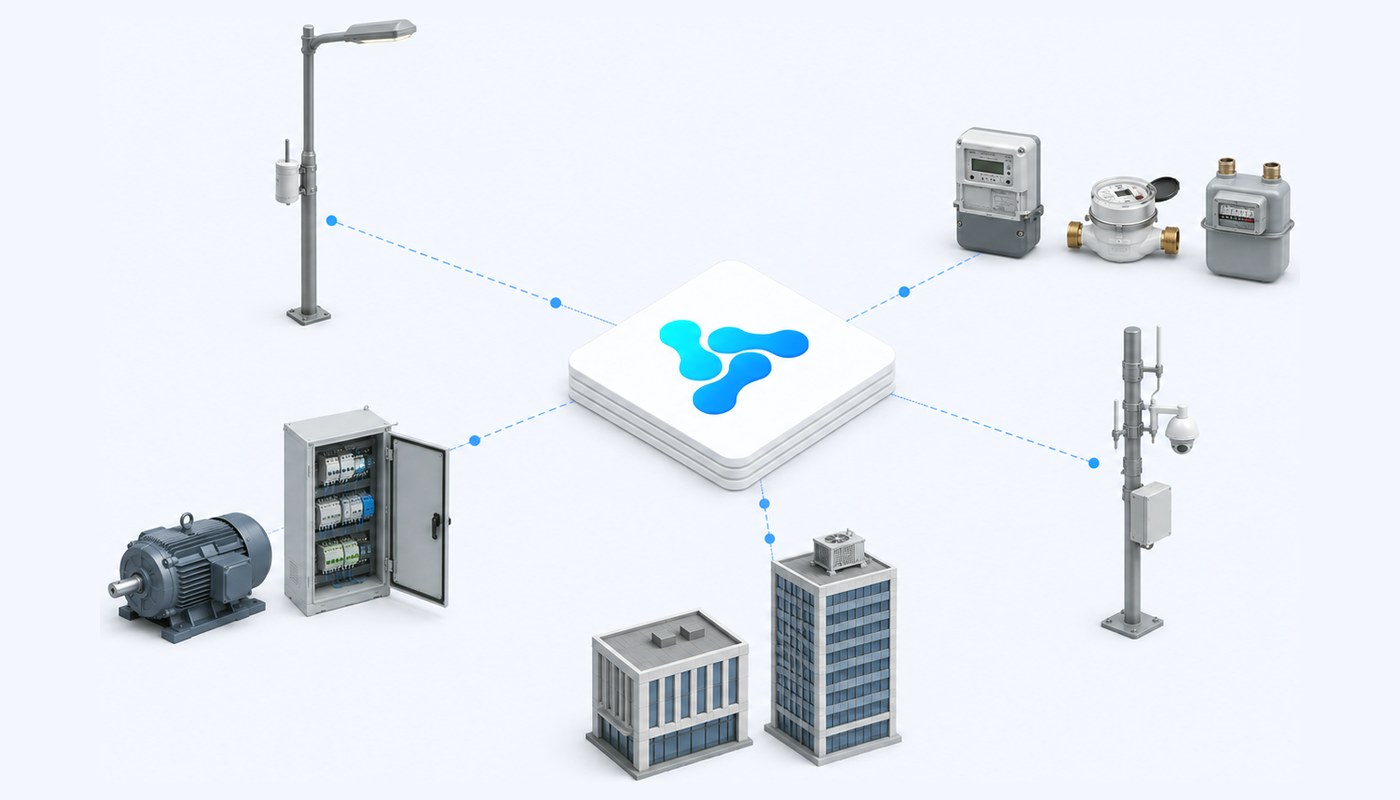
One platform. Different operational realities.
Use the same platform foundation across multiple infrastructure domains.
Shared difficulty
The same five problems, in different clothes.
Sectors describe their difficulties in their own vocabulary. Underneath, the shape is remarkably consistent.
Fragmented systems
Assets were procured in separate projects, each with its own interface, its own accounts and its own idea of what a device is.
Remote assets
The things being operated are spread out, often unattended, and expensive to visit. Anything that requires a site trip limits how often you can know.
Vendor diversity
Several manufacturers and several generations coexist, and none of them is going to be replaced just to make the software simpler.
Manual workflows
Work that could be a condition and an action is instead a person checking a screen, exporting a file, or remembering to do something.
Limited operational context
A value on its own is not enough. Without the asset it belongs to, its location and its history, it cannot support a decision.
What differs
What actually changes between sectors.
Being honest about the differences is what makes the claim of a shared platform credible.
The equipment
A luminaire, a water meter, a pump and a camera behave nothing alike. They are described as different models, with their own parameters and templates.
The protocols
A city may run LoRaWAN, a plant Ethernet and a campus something else again. Each protocol is its own configurable service instance.
Who operates it
A municipal department, a utility control room and a facilities team have different shifts, skills and screens. Roles and dashboards differ accordingly.
What accountability means
For one organisation it is a regulator, for another an internal audit, for another a contract. The audit trail is the same mechanism; what it is used to prove is not.
How installations are grouped
A district, a plant, a building or a contract each becomes an IoT system, with its own inventory and retention policy.
The pace of change
Some estates change monthly, others once a decade. Models and versions are what let both be described without a rewrite.
What stays the same
How one platform absorbs the difference.
Six mechanisms carry the variation, which is why a second sector does not mean a second platform.
1
Model, version, instance
Any equipment is described at three levels, with attributes inherited downwards and overridable locally. Nothing needs a special case.
2
Dynamic attributes
Parameters, metric templates and command templates describe arbitrary devices instead of forcing one rigid schema on all of them.
3
Protocols as service instances
A new protocol is a configurable, containerised service, not a change to the core.
4
Organisational units and roles
The structure of the operator is modelled too, so departments keep their scope inside a shared platform.
5
IoT systems and groups
Installations and working groupings are first-class, so the platform can match how the estate is actually run.
6
One audit mechanism
The same change history applies to every entity, whatever the sector needs it to prove.
This is the whole argument. The variation between industries lives in configuration — models, templates, rules, roles and screens — rather than in separate software that has to be maintained in parallel.
Solutions
What you would actually deploy.
Industries describe who you are. Solutions describe what gets built. Most organisations start with one and add the next.
Smart Lighting
Individual and group control, dimming, schedules, fault monitoring and energy metrics.
Smart Environment
Temperature, humidity and particulate readings as comparable metrics, with threshold rules.
Smart Metering
Electricity, water and gas meters in one model, with timestamped consumption metrics.
Smart Infrastructure / SCADA
A supervisory layer over existing control, with validated commands and shared history.
Smart Buildings / BMS
Lighting, energy and environment across a portfolio, with policy applied as rules.
Smart Video & Analytics
Detections as operational events that rules can act on across other equipment.
Tell us how your infrastructure works today.
We will map it to the Vision Smart Platform architecture.