Cities & Public Infrastructure
Connect city infrastructure through one operational layer.
Lighting, environment, public assets, GIS and automation in a unified smart-city operating environment.
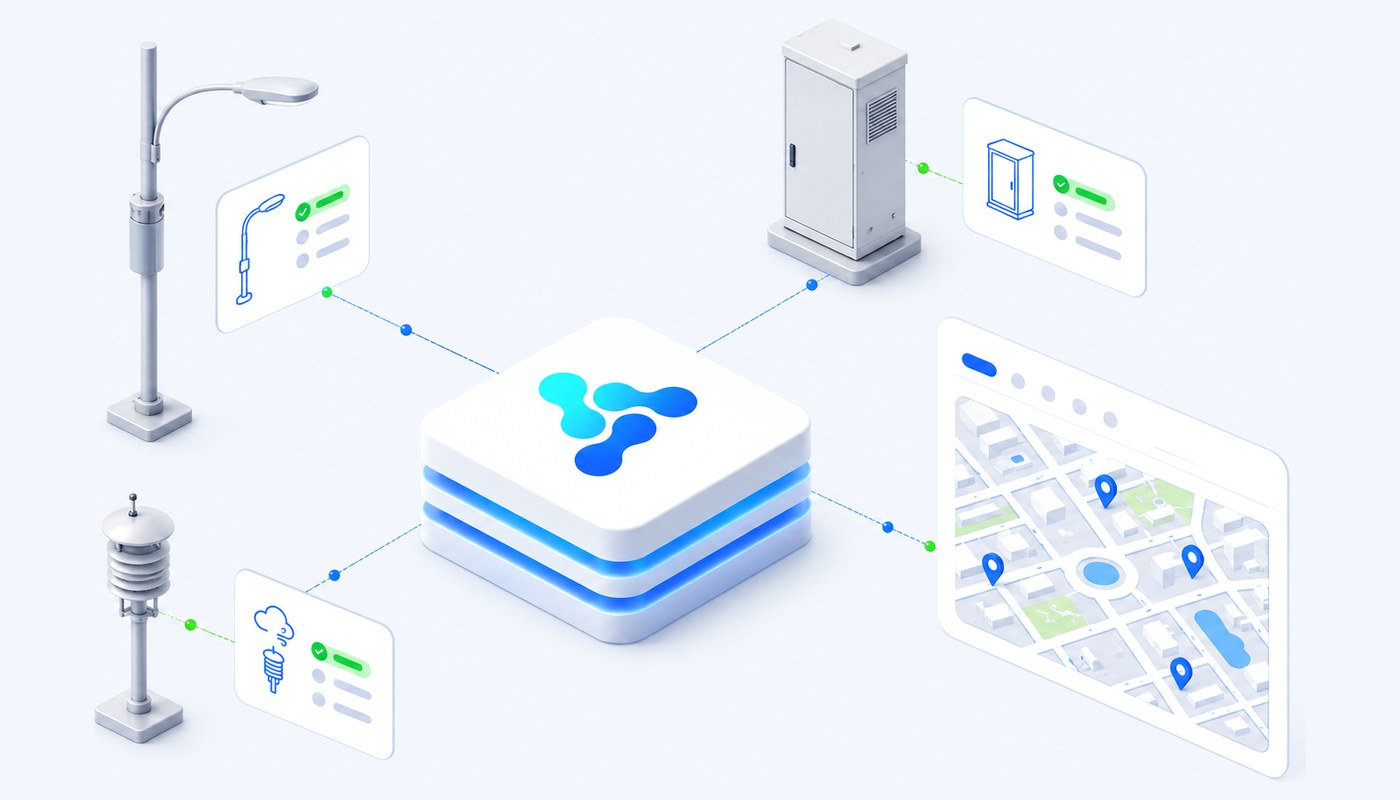
What a city operates
Public infrastructure is an estate, not a project.
The assets are numerous, spread across the whole territory, and owned by departments that answer to different people.
Street lighting
Usually the largest single population of connected assets a city owns, and the one where operating cost is most visible.
Environmental monitoring
Sensors reporting temperature, humidity and particulates, whose value depends on being comparable across the territory.
Metering
Consumption across public buildings and utilities, where the useful question is always relative: compared with what.
Cameras and detection
Equipment that already recognises events, but usually cannot pass them to anything that would act on them.
Controllers and cabinets
The equipment that makes the rest work, and that is only noticed when it fails.
The territory itself
Districts, zones and contracts — the shapes the assets are actually managed in.
Where it gets hard
Procurement shapes the software, and the software outlives the procurement.
Cities rarely have a technology problem. They have an accumulation problem.
Each project brought its own system
A lighting contract, an air-quality programme and a metering rollout each arrived with a portal, and none of them was designed to meet the others.
Departments cannot share without losing control
Sharing a platform is easy to say. Doing it without a department losing authority over its own assets is the part that usually fails.
Nothing survives a handover
When a contract ends or people move, the operational knowledge often leaves with them, because it was never written into the system.
What the platform gives a city
Shared where it helps, separate where it must be.
The mechanisms that let several departments operate inside one platform without giving up their own scope.
One inventory of public assets
Every luminaire, sensor, meter, camera and controller in one registry, each with its model, version and location.
Organisational units that mirror the city
The structure of the administration is modelled, and roles and permissions follow it — so a department operates its own assets, not everyone else’s.
Districts and contracts as IoT systems
An area or a contract becomes its own operational context, with its inventory, dashboard and retention policy.
One map for the territory
Assets, groups and systems on a single interactive map, with filters and map profiles per operational view.
Rules across departments
A condition can combine a detection, a reading and the time of day, even when those belong to different domains.
A calendar the city recognises
Rules can evaluate date, time and day against a configurable calendar of public holidays.
Dashboards per audience
A technician, a department head and a director need different screens, defined per installation.
Handover that actually works
Practically every entity carries an audit trail with old and new values, so operational knowledge stays in the system.
Room for the next domain
A city can start with one solution and add the next without changing the foundation underneath it.
Where to start
The solutions cities usually deploy first.
Most start with the domain where operating cost is most visible, and add the next on the same foundation.
Smart Lighting
The largest asset population and the clearest operating cost. Individual and group control, dimming, schedules and fault monitoring.
Smart Environment
Temperature, humidity and particulate readings as comparable metrics, with threshold rules that act on their own.
Smart City Operations
Several domains in one registry, one map and one rule engine, with departmental scope preserved.
Smart Video & Analytics
Detections that become operational events other equipment can respond to.
Smart Metering
Consumption across public buildings, timestamped and comparable between sites and periods.
Smart Buildings / BMS
Municipal buildings as a portfolio, with policy applied as rules rather than site by site.
What it is built on
The platform capabilities behind a city deployment.
Each of these has its own page, with what it does and how it is configured.
Digital Twins & Device Lifecycle
Public assets as models, versions and instances, in one registry with one lifecycle.
GIS & Spatial Operations
One interactive map for the territory, with filters, shapes and map profiles per view.
Rules & Automation
Conditions that cross domains, with priorities and operational enable or disable.
Enterprise Administration
Organisational units, operators, states, units of measure and the public holiday calendar.
Security & Audit
Roles and permissions per organisational unit, and a change history on practically every entity.
Connectivity & Integration
Protocols as containerised service instances, so a mixed field estate is normal.
Fit with how a city actually works
Discuss your infrastructure.
We will help map your current architecture and operational goals to Vision.